TEAM TRAINING – SUNDAY 7th JAN 2018: WINTER TECHNIQUES AND RECCE OF ACCESS TO TOP OF CIOCH NOSE FROM SGURR A’CHAORACHAIN
Group members: Ade, Jo, Kenny, Ronald, Charlie, Gregor, Graham and Martin
Summary of Day: We walked up to the Sgurr a’Chaorachain mast and inspected the descent into Coire a’Charoachain which is normal way for climbers to get to the bottom of the Cioch Nose. We spent 30 minutes setting up snow belays and discussing ways of getting a group down the headwall of this descent when there is a cornice or conditions are icy. Then, we roped up alpine-style into two teams and climbed down the route towards the top of the Cioch Nose. In winter conditions the route, which traverses several rocky knolls, is exposed and should be classed as a grade II climb. In the event of needing to rescue a group from the Cioch Nose it would be necessary for a team to descend this route with equipment. We adopted several different methods of roping and belaying and reached the bottom of the biggest step of the ridge before lack of time forced us to return. We were still some 45 minutes’ climbing time away from the top of the Cioch Nose route when we turned back.
Summary of Learning Points:
- Gearing up “ritual” – really important that all individuals concentrate on gearing up properly whatever the stresses and time-pressures of the situation; no dangling slings or loose crampon straps. All hardware should be racked on harness or round shoulders – ie don’t leave any of it in the rucksack.
- Stomper, T-axe and Bollard belays were compared as means of getting a group down a short roped descent of a headwall which is close to vertical. The stomper was effective and much the quickest method, saving 5-10 minutes over the other two. Members can back-climb with tension from above, but the drawback is that last person down must solo without protection. An abseil from a bollard allows all members to descend with protection of the rope and was second fastest. T-axe belay with bucket seat took the longest and has the same snag that the last person must descend solo unless axes are left in place.
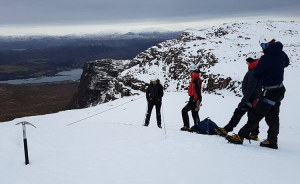
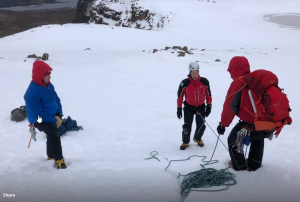
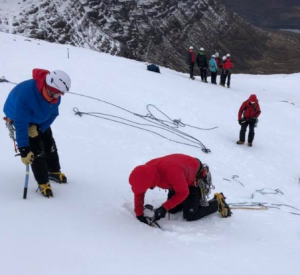
- Alpine Short Roping was adopted as the default system for the descent to the Nose. Useful for all team members to be adept at taking coils round the shoulder and tying them off, then walking and scrambling with coils in hand and a short rope (3-4 metres) to other members. Uses and benefits – i) confidence roping of victims who can be walked off the hill; ii) keeping the team together for communication and teamwork; iii) being roped allows a rapid transition to belayed pitched climbing. What about risk that if one person slips everybody gets pulled off? Experience shows that if the rope is kept tight between all members it is possible to stop a slide in 75%+ of instances by adopting an axe brake and digging toes into slope. We didn’t practice this scenario!
- Down-climbing an Exposed descent. We were all a bit awed by the exposure of the 30 metre descent to the first gap on the ridge; the snow had an icy crust and any fall would have serious consequences. The groups set up multi-point anchors and the ‘leaders’ – Kenny and Ron – belayed the others in a down-climb. During the down-climb the others placed running belays, so that the leaders had protection when they climbed down (belayed from below). We could have abseiled, but that would have been slower and would have meant leaving gear behind.
- Transition back to Alpine Short-roping. Having spent 30 minutes on the down-climb it was important to revert to faster short-roping without belays as soon as the terrain eased. We traversed the next knoll in 10 minutes.
- Moving together. The next step down is about 70 metres high and quite exposed. We were aware of time pressure so decided to move together with running belays on the rope. This worked really well, as we found some good cracks and spikes for anchors. The first person on the rope placed the anchors which were back-clipped along the rope and the leader (coming last on the descent) took them out. That way the groups kept moving and always had at least one piece of protection on the rope in case of a slip.
- Setting up an Abseil. The last 20 metres of the descent were steeper so we decided to set up an abseil. Two good thread anchors were found and equalised to a single point with a large HMS Krab. Use of the Petzl Connect lanyards was very effective to get four people quickly clipped-in.
- Personal Abseil Rig. Good for everyone to adopt the same method:- Short sling 15-20cm with larks foot from harness belay loop to abseil plate (not thin Dyneema). Autoblock prusik attached direct from harness belay loop to abseil rope below the abseil plate. Only first person down needs to use the prusik. Best length for personal both prusik cords is 1.20 metres (5 or 6mm cord) tied with the “double fisherman” to give a doubled length of 30cm. Some in group had shorter prusiks, which couldn’t make an autobloc
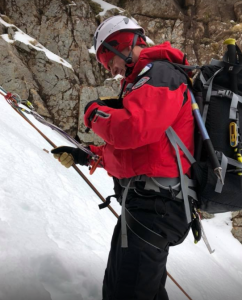
- Stacked Abseil. When there is enough space at the abseil station all the members should load on to the abseil before the first guy goes down – so that each can make visual check of the others’ rig. Once loaded and checked the Petzl Connect lanyards can be detached, and the abseil can begin. Stacking the abseil is quicker than loading individually.
- Cutting Corners on the Return Journey. Now we had run out of time and risked Arjan’s wrath should we push on and then return late. Ade and Graham went down the abseil and were top-roped back up by Kenny and Greg. The return journey felt much easier, because there were now good tracks to follow and the steep sections were taken in ascent. There was also greater confidence among all members that they could safely handle the terrain without belays. We moved together with runners back to the top of the big step then did the rest alpine-style on a short-rope, moving without belays up the step that we had belayed on the way down. It may seem illogical to adopt less secure methods than were deemed necessary on the way down, but these decisions are highly subjective to varied according to conditions and confidence levels. As a result, we saved time and got back to the team vehicles 10 minutes in advance of our Team Leader.
- Rigging the route on a Real Rescue. Charlie made a good point that on a real ‘shout’ we could cut time by leaving some lengths of fixed line on the steep sections. Worth having several 20-30 metre lengths of 9mm rope for handrails and single 10mm line for abseil.
- Getting to the Cioch Nose. In summer conditions the whole route from the mast down to the top of the route could be done in 1 hour. A team could short-rope or solo the whole way. In winter conditions, with heavy loads of rescue kit and adding in bad weather and darkness the mission could take 2 ½ hours, and that’s just to get to the first big abseil down the route! The final knolls can be by-passed by a terrace on the south side, avoiding a couple of exposed scrambles. Would need at least 6 people to get kit and long ropes down to route (8 if a stretcher was carried as well).
Martin Moran 8th Jan